Opening My Eyes

I began watching the Netflix limited series When They See Us months ago. I stopped after Episode 2, telling myself I would finish it soon but my heart was too heavy to complete it then. My heart? I am a white, middle-class woman who raised a white daughter. I can never know what it means to raise a black son in the United States. The fear–make that terror–of wondering if my child will be beaten, imprisoned, or killed simply for his skin color. How could I possibly grasp living with that in my mind day in and day out.

Over the weekend, I returned to the story of the the Central Park five. It was, once again, difficult to watch, but I want to know the story. I need to see the ways in which the society I take part in and pay taxes in accuse and condemn black men, or worse children, and send them to prison in for greater numbers than white men. Michael Eric Dyson in his piece, “Letter to My Brother, Everett, in Prison” write, “Too many black men are jailed for no other reason than that they fit the profile of a thug, a vision developed in fear and paranoia” (20). What is the “profile of a thug?” Where and how did we create this? I say we because I have benefitted from the white supremacist society and I have, of course, done and said racist things. If you are white in the United States, so have you. I think about the young black men I teach and advise. I fear for them. I feel for those who raised them and all who love them. What must it be like to know that your country is afraid of you because it is a racist nation not because it sees you or knows you?

I have told myself I will get involved with area organizations working in the prisons and fighting to end the mass incarceration of Black people that plagues this country. Let me be clear about this: mass incarceration of black and brown bodies is a plague and one of the largest social justice issues today. Want to know more? Visit the Equal Justice Initiative site at https://eji.org/criminal-justice-reform/ When am I going to make the calls, send the emails, and put myself in the trenches to fight this evil? I task myself with doing that today. I cannot sit idly by and watch racism destroy more of our country and if unchecked, it will. It most certainly will.

I want to make it clear that I am not asking for any praise for anything I do. When colleagues tell me I am doing great work on my campus, my response is and will always be, “It is not enough.” I have to work harder and with more understanding and knowledge of racism every day to dismantle the systemic racism in the United States, which filters into every aspect of life–schools, politics, government, voting rights. Oh, the issues of mass incarceration and voting. A future post remains to be written solely on that issue–robbing people of citizens’ rights to vote while counting their bodies as part of the population of a voting district. It is unethical. It reeks of how some politicians cheat the system to win at all costs.

Please hold me accountable not laudable. I need to learn. I need to fight. I ask that you, white reader, do the same.

Reference- Dyson, Michael Eric. “A Letter to my Brother, Everett, in Prison.” The Michael Eric Dyson Reader. Basic Civitas, 2004, pp. 19-21.
Where Have I Been?

Well, I have not been blogging it seems. I have thought about posting discussions on Brittany Cooper’s Eloquent Rage, Michael Eric Dyson’s writing, white men who take up too much space. All of this has been running through my head, but I have been distracted by work obligations. Ugh.

A main reason why I started my blog was to grow as a person when it comes to white supremacist tendencies. I want to explore more about systemic racism, read articles and books in which Black writers generously share their experiences with racism. However, I have not been devoting the time necessary to do this important work on myself. How can I fight racism in society, if I am not introspective enough about my own racist shit?

Do better I must.

Accomplice, Ally, or Neither?

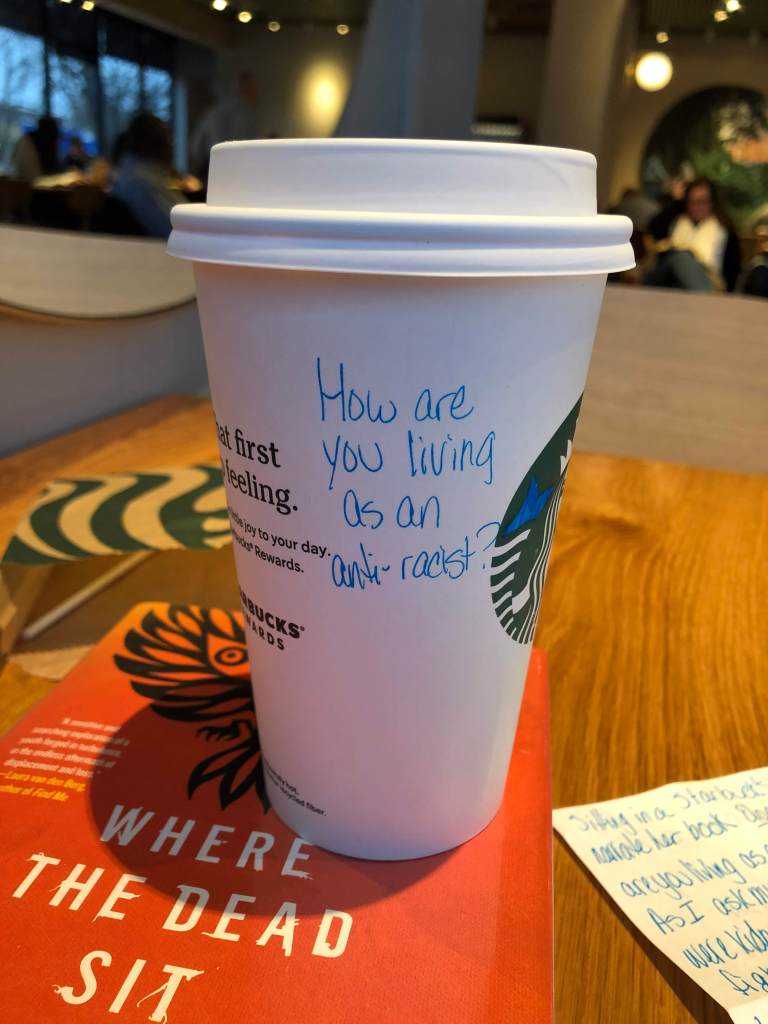
Starbucks cup sits on top of an orange book. On the cup in blue pen reads “How are you living as an anti-racist?”

Sitting in a Starbuck’s in KCMO. Listening to Brittney Cooper narrate her book Eloquent Rage and writing the words “How are you living as an anti-racist?” on my empty grande paper cup. As I ask myself where I was mentally when the Nigerian school girls were kidnapped in 2014, I know I was absent. Absent from the fight to make these girls “important enough” (Cooper’s words) for the US to take action and rescue them from a horrific fate. I needed to be there in that moment.

I strive now to be present. I do not always succeed. Some days it feels like too much to read one more news story about a young Black man assaulted or shot in the name of the almighty law or how the US government broke every treaty made with Native Americans. And this, my readers, is white privilege. I have the privilege to turn the other way and close myself off to the truths people of color must grapple with and fight every day. I can save a news story for later and read it or not. It may sit “saved” without my ever looking at the headline again, much less the details of the story revealing a reality I do not have to see if I choose not to.

However, neither reading a story later nor ignoring it completely is acceptable. If I am going to call myself an accomplice in the fight against racism, I need to show up every day. Every. Damn. Day. Emotional energy depleted or not, I have an obligation as a white person who wants to be better and do better.

My accomplice role, and I feel both compelled and honored to fight for it, is not an accessory, an outfit, or pair of shoes that can be put on or taken off at whim. If so, I cannot–must not–claim it. I have no desire to be an ally. Not that I am suggesting others should not do the work of an ally. For me, an ally is not enough. My obligation to my community means living in the trenches and fighting diligently not occasionally when convenient. I must take the time to work on this consistently.

As I was drawing on my cup, I saw one of “my” Black Student Union student’s messages on our organization’s GroupMe. She was wishing me a happy birthday and thanked me for being a “wonderful” advisor. Her words made me teary, both because these Black students honor me with their trust as a white advisor and because more white people need to be present for these Black students and the Black communities around them. C’mon, white folks, do better. I know I need to.

(Written on a receipt from my dog’s vet on Dec. 28. Typed up and edited Jan. 2.)

How Did I Get Here?

It is safe to say that my journey to become an anti-racist began in August 2018–the day the Black Student Union (BSU) on my institution’s campus interviewed me to support them as a faculty advisor. Prior to their generosity in moving me mentally forward, I would have said loudly, “I am not a racist.” Now, I know better. As a white woman raised in the white supremacist culture of the United States, racism was taught to me and I have privileges in my society because of the system. (White people, please read Robin Diangelo’s White Fragility for a more articulate and detailed explanation of this.) I also know that being “non-racist,” or claiming to be, is not enough. In fact, being an ally in the fight against racism as an anti-racist is not enough. However, being an accomplice in fighting racism is where it’s at. (Shout out to Symone Sanders for teaching me this in her talk at Big XII 2019.) I have to be in the trenches fighting not merely providing support.

Fighting racism brings me back to BSU. In my August 2018 interview for the most meaningful work I have done at the job I have worked in for 2.5 years, I was told only one response of mine mattered. I can see the beautiful face of the BSU President and the intense look in her eyes when she asked, “When shit goes down, and it will go down, will you be there for us?” Other officers there, past and present at that time, confirmed through nods and words of agreement that “shit would go down.” I replied, “If I am in, I am all in. And, I am in if you want me.” A week or two later, at the first membership meeting of fall semester 2018, I was voted in as BSU’s faculty advisor. I am forever thankful for the leap of faith these students took on a white professor.

Quickly, I learned that shit would, indeed, go down. When it did, I came to see how I could use my privilege as both white and a professor to fight in the trenches. Racist comments directed toward BSU at a campus sponsored event spurred students into action, making formal complaints and requesting disciplinary action. In order to help students make a case, I knew I had to be savvy with my approach. I did what I do well–I researched. With the help of articles by Arlie Russell Hochschild, Monica T. Williams, Stephanie Saul, and others, I constructed an email with statistics about microagressions (I prefer Ibram X. Kendi’s term “racial abuse”). I let administrators know that what happened was no small matter. Retention rates, something our administration worries about, came up in my email–with backed research on how verbal racial abuse plays a vital role in students of color choosing to stay or leave a PWI.

Although the matter was not resolved to the satisfaction of BSU, it was also not ignored. It could not be. This “incident” was my first step into the shit and a tiny glimpse into the world of my black students and what they experience on our campus and in the world around us. I grew angry during this process of negotiation between BSU and administrators. In addition to anger, I felt a pain in my chest. It was the pain of knowing people who matter to me were walking around in the world facing hate and ignorance daily. Racism became more real. My need to be better and do better in the systemic white supremacist society surrounding me was intense.

Since that fateful August day in 2018, I have learned more about racism, and I journey to be an accomplice in the fight against racism.

Thank you, BSU. You are why I am here.

Featured

Trying to Process Lynch Laws

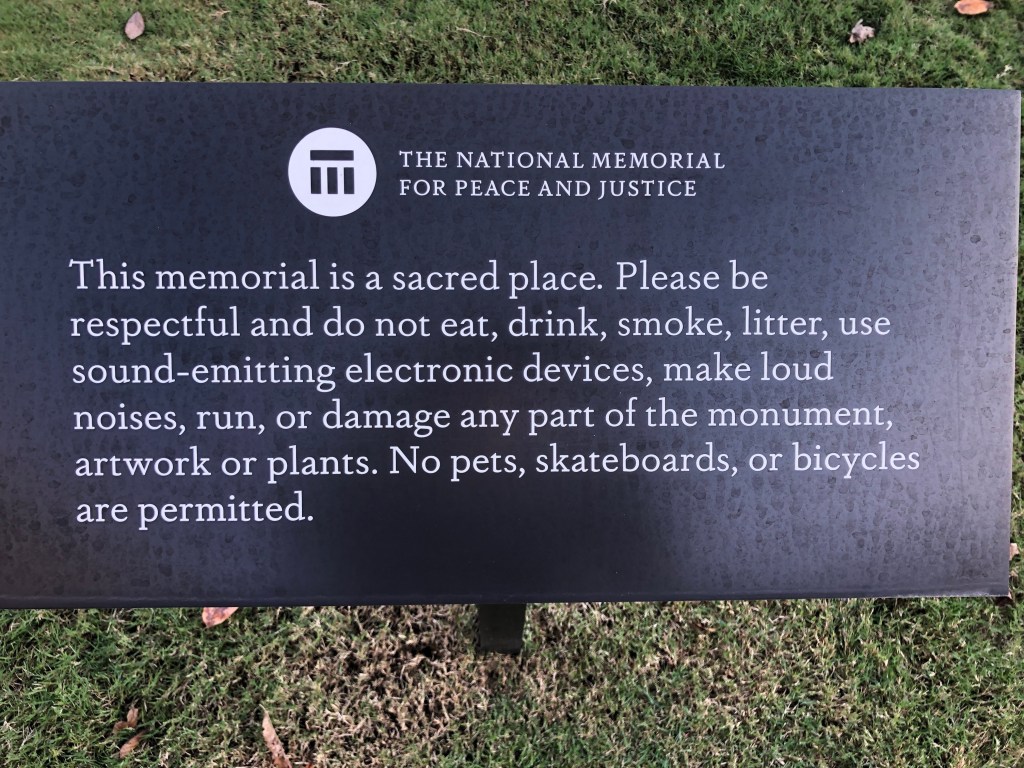
Sign at The National Memorial for Peace and Justice that reads: This memorial is a sacred place. Please be respectful and do not eat, drink, smoke, litter, use sound-emitting electronic devices, make loud noises, run, or damage any part of the monument, artwork, or plants. No pets, skateboards, or bicycles are permitted.
https://museumandmemorial.eji.org/memorial

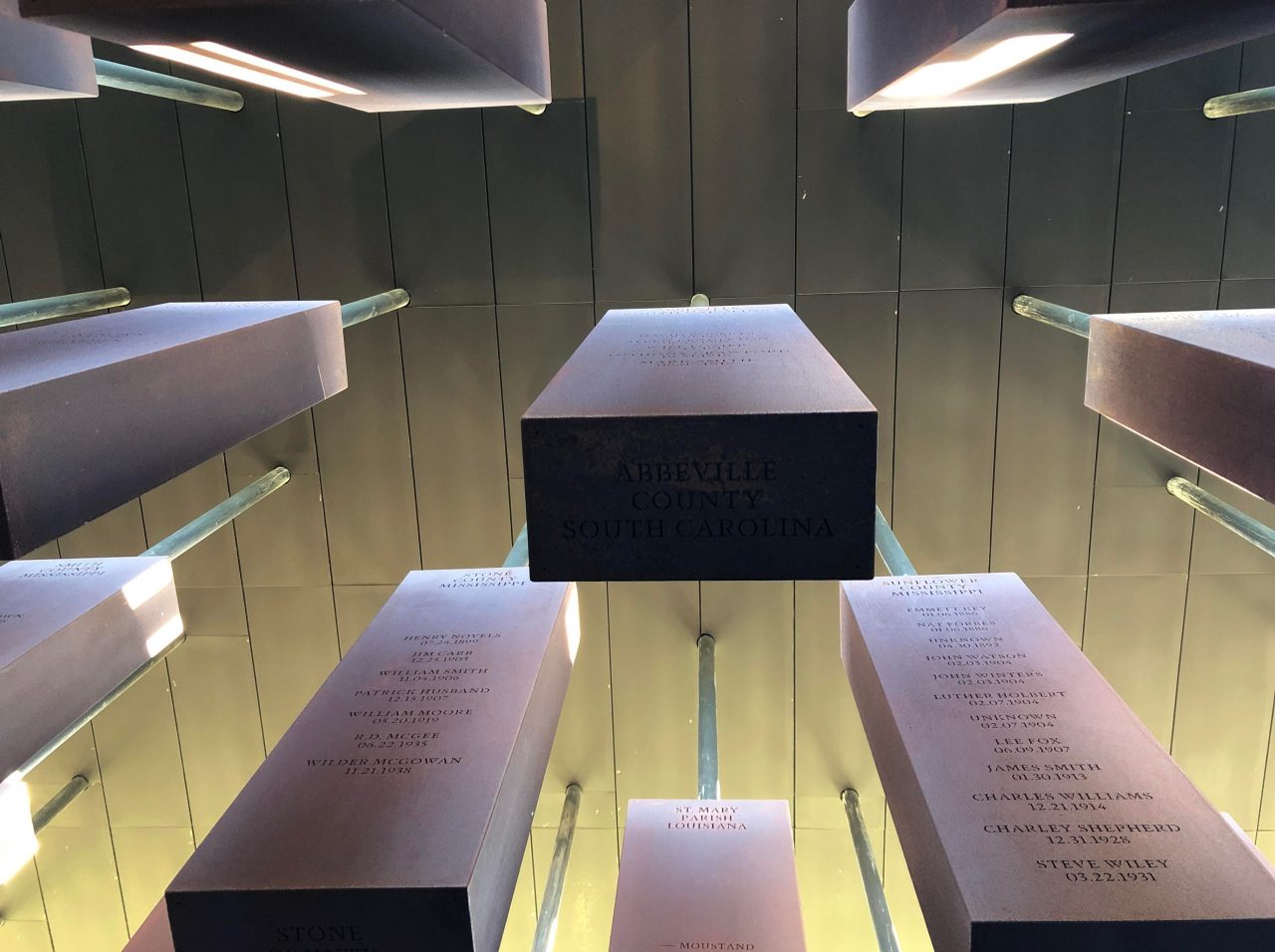
Two weeks have passed since I walked through this memorial site in Montgomery, AL. Now, as I sit in a hotel room in Seal Beach, CA, thinking about this “sacred space” creates a tension in my shoulders and a pain in my chest. Flying out to CA yesterday, I read about Ida B. Wells, her anti-lynching work, and the history of her activism. Wells’ writing is something I am considering teaching in the class this spring as it would provide historical context for The National Memorial for Peace and Justice while acknowledging the remarkable public work of a black woman in the late 1800s.

As I delved further into Jacqueline Jones Royster’s comprehensive history of lynching in the U.S. https://www.amazon.com/Southern-Writings-Anti-Lynching-Campaign-1892-1900/dp/0312116950/ref=sr_1_2?keywords=royster+ida+b+wells&qid=1573852873&sr=8-2, I couldn’t help but think about the black men I have known and cared about. From friends at youth summer camp to recent adult boyfriends, black boys and men have been in my life in meaningful ways. While I may feel stares when I walk into a Starbucks in Kansas with a black man, I am not concerned for his life because he is with me, because we rode in the same car, because we sit close to one another drinking our overpriced, over-sugared specialty drinks. Lynching would have been the price he paid in the past. In the rancid, blood-stained past of this country I call home. How do I process this?

On Southwest flight 2046, I was unable to process it. Royster writes, “Lynching was not simply a spontaneous punishment for crimes but an act of terror perpetrated against a race of people in order to maintain power and control” (3). Systemic violence. Protected hate. Ceremonial murder. Wells made it clear in her writing that a majority of lynchings were a white male response to relationships between black men and white women. Would I have been one of these women whose desire for and/or love of a black man meant the loss of his life? Would I have risked someone else’s life that way? Is that in me? I don’t know answers to questions I cannot ask.

White people’s hate and fear killed under the actions of lynch law in brutal inhumane ways–as if kidnapping and murdering could be anything but brutal and inhumane. Today this hate and fear comes in the form of police violence, unfair and harsh prison sentences, among other oppressive white supremacist forces. I ask myself, “Where am I in this system? How do I fight it?”

While here in CA, I will pull Ibram X. Kendi’s How to be an Antiracist out of my bag, so that I can answer questions about who I am today and what my obligation is to be better and do better. Too much. Too much. Too much killing. Too much hate and fear. How can I ever do enough?

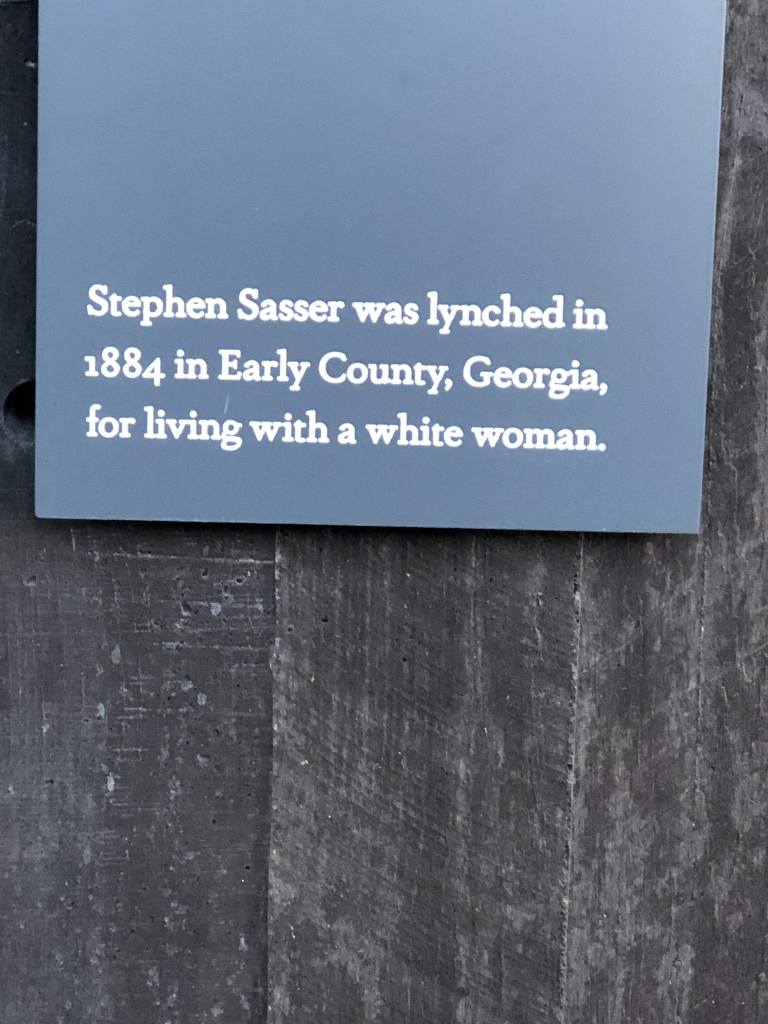
Grey sign mounted on a dark wood board reads: Stephen Sasser was lynched in 1884 in Early County, Georgia, For living with a white woman.
Racism. Fear. Anger. Jealousy. Murder.
Featured

Dr. Muffy’s Journey

Documenting my journey in co-teaching a course on Civil Rights. Join me as I learn more each day about how I can fight white supremacy and transform myself and, I hope, others.

Why?

  • I have the privilege of being white, cis, and hetero
  • I need to use this privilege to fight social injustice
  • Fighting racism is a journey in the self and society
  • White supremacy destroys everyone

“I imagine one of the reasons people cling to their hates so stubbornly is because they sense, once hate is gone, they will be forced to deal with pain.” – James Baldwin

  • White people need to have difficult conversations about race
  • Blogging about my journey forces me to go public with what I am learning about myself and society
  • Others may find a sense of discomfort in reading this and deep learning comes from discomfort
  • I hope my students see from my blog that opening oneself up to learn, deep self-reflection, and taking action will transform their lives.